Malcolm X was born Malcolm Little in 1925 in Omaha, Nebraska. His mother, Louis Norton Little, was a homemaker occupied with the family's eight children. His father, Earl Little, was an outspoken Baptist minister and avid supporter of Black Nationalist leader Marcus Garvey. Earl's civil rights activism prompted death threats from the white supremacist organization Black Legion, forcing the family to relocate twice before Malcolm's fourth birthday. Regardless of the Little's efforts to elude the Legion, in 1929 their Lansing, Michigan, home was burned to the ground, and two years later Earl's mutilated body was found lying across the town's trolley tracks. Police ruled both incidents accidents but the Little's were certain that members of the Black Legion were responsible. Louise had an emotional breakdown several years after the death of her husband and was committed to a mental institution. Her children were split up amongst various foster homes and orphanages. Malcolm was a smart, focused student and graduated from junior high at the top of his class. However, when a favorite teacher told Malcolm his dream of becoming a lawyer was "no realistic goal for a nigger," Malcolm lost interest in school. He dropped out, spent some time in Boston, Massachusetts, working various odd jobs, and then traveled to Harlem, New York, where he committed petty crimes. By 1942 Malcolm was coordinating various narcotic, prostitution, and gambling rings. Eventually Malcolm and his buddy, Malcolm "Shorty" Jarvis, moved back to Boston where they were arrested and convicted on burglary charges in 1946. Malcolm placated himself by using the seven-year prison sentence to further his education. It was during this period of self-enlightenment that Malcolm's brother Reginald visited and discussed his recent conversion to the Muslim religious organization the Nation of Islam. Intrigued, Malcolm studied the teachings of Nation of Islam leader Elijah Muhammad. Muhammad taught that white society actively worked to keep African-Americans from empowering themselves and achieving political, economic, and social success. Among other goals, the Nation of Islam fought for a state of their own, separate from one inhabited by white people. By the time he was paroled in 1952, Malcolm was a devoted follower with the new surname "X." He considered "Little" a slave name and chose the "X" to signify his lost tribal name. Intelligent and articulate, Malcolm was appointed a minister and national spokesman for the Nation of Islam. Elijah Muhammad also charged him with establishing new mosques in cities such as Detroit and New York. Malcolm utilized newspaper columns, radio. and television to communicate the Nation of Islam's message across the United States. His charisma, drive, and conviction attracted an astounding number of new members. Malcolm was largely credited with increasing membership in the Nation of Islam from 500 in 1952 to 30,000 in 1963. The crowds and controversy surrounding Malcolm made him a media magnet. He was featured in a week-long television special with Mike Wallace in 1959, "The Hate That Hate Produced", that explored fundamentals of the Nation of Islam and Malcolm's emergence as one of its most important leaders. After the special, Malcolm was faced with the uncomfortable reality that his fame had eclipsed that of his mentor Elijah Muhammad. Racial tensions ran increasingly high during the early 1960s. In addition to the media, Malcolm's vivid personality had captured the government's attention. As membership in the Nation of Islam continued to grow, FBI agents infiltrated the organization (one even acted at Malcolm's bodyguard) and secretly placed bugs, wiretaps, and cameras surveillance equipment to monitor the group's activities. Malcolm's faith was dealt a crushing blow at the height of the civil rights movement in 1963. He learned that Elijah Muhammad was secretly having relations with as many as six women in the Nation of Islam, some of which had resulted in children. Since his conversion Malcolm had strictly adhered to the teachings of Muhammad, including remaining celibate until his marriage to Betty Shabazz in 1958. Malcolm refused Muhammad's request to keep the matter quiet. He was deeply hurt by the deception of Muhammad, whom he had considered a prophet, and felt guilty about the masses he had lead into what he now felt was a fraudulent organization. When Malcolm received criticism after the assassination of President John F. Kennedy for saying, "Kennedy never foresaw that the chickens would come home to roost so soon," Muhammad "silenced" him for 90 days. Malcolm suspected he was silenced for another reason. In March 1964 he terminated his relationship with the Nation of Islam and founded the Muslim Mosque, Inc. That same year, Malcolm went on a pilgrimage to Mecca, Saudi Arabia. The trip proved life altering, as Malcolm met "blonde-haired, blued-eyed men I could call my brothers." He returned to the United States with a new outlook on integration. This time, instead of just preaching to African-Americans, he had a message for all races. Relations between Malcolm and the Nation of Islam had become volatile after he renounced Elijah Muhammad. Informants working in the Nation of Islam warned that Malcolm had been marked for assassination (one man had even been ordered to help plant a bomb in his car). After repeated attempts on his life, Malcolm rarely traveled anywhere without bodyguards. On February 14, 1965, the home where Malcolm, Betty and their four daughters lived in East Elmhurst, New York was firebombed. The family escaped physical injury. At a speaking engagement in Manhattan's Audubon Ballroom on February 21, 1965, three gunmen rushed Malcolm onstage and shot him 15 times at close range. 39-year-old Malcolm X was pronounced dead on arrival at New York's Columbia Presbyterian Hospital. Fifteen hundred people attended Malcolm's funeral in Harlem at the Faith Temple Church of God in Christ on February 27, 1965. After the ceremony, friends took the shovels from the gravediggers and buried Malcolm themselves. Later that year, Betty gave birth to their twin daughters. Malcolm's assassins, all members of the Nation of Islam, were convicted of first-degree murder in March 1966.


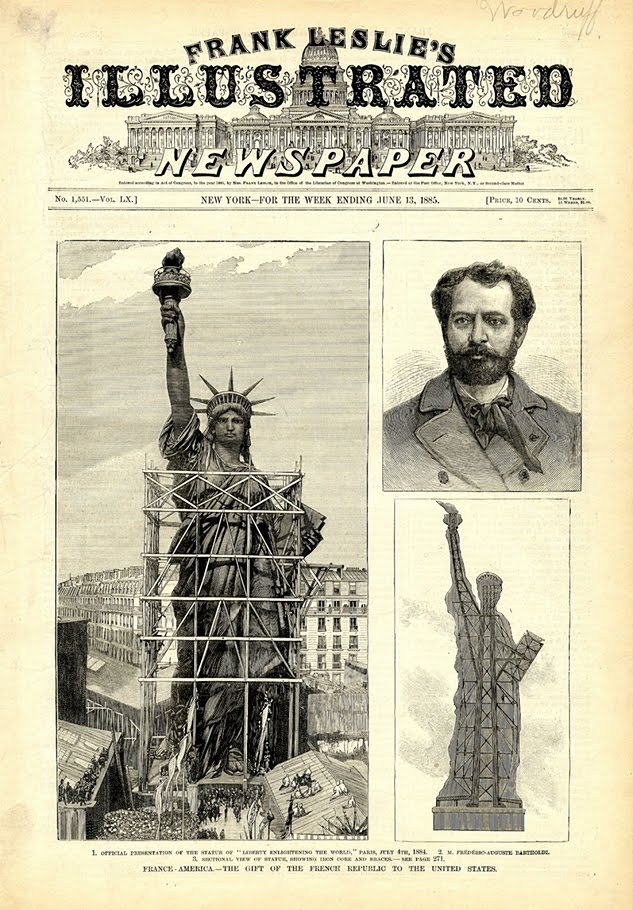
 The Statue of Liberty is the tallest metal statue ever constructed and, at the time it was completed, was the tallest structure in New York City at 22 stories high. It stands 151 feet high and weighs 225 tons. The statue's arms are 42 feet long and its torch is 21 feet in length; its index fingers are eight feet long and it has a 4-foot 6-inch nose. The copper sheeting weighs 200,000 lbs. There are 167 steps from the land level to the top of the pedestal, 168 steps inside the statue to the head, and 54 rungs on the ladder leading to the arm that holds the torch. Since 1886 she has stood proudly in New York Harbor, in a naturally very corrosive marine environment. A gift from the French people to the American people, master sculptor Frederic-Auguste Bartholdi had originally envisioned this to be a new Wonder of the World to mark Egypt's Suez Canal. After history and politics got in the way, Bartholdi looked to America and saw the perfect gift to celebrate America's Centennial. Edouard de Laboulaye, French historian and admirer of American political institutions, suggested that the French present a monument to the United States who would provide the pedestal and the site. Bartholdi visualized a colossal statue at the entrance of New York harbor welcoming the peoples of the world with the torch of liberty. On Washington's Birthday, February 22, 1877, Congress approved the use of a site on Bedloe's Island suggested by Bartholdi. This island of 12 acres had been owned in the 17th century by a Walloon named Isaac Bedloe. It was called Bedloe's Island until August 3, 1956, when President Dwight D. Eisenhower approved a resolution of Congress changing the name to Liberty Island. The statue was finished May 21, 1884, and formally presented to the U.S. minister to France, Levi Parsons Morton on July 4, 1884, by Ferdinand de Lesseps, head of the Franco-American Union, promoter of the Panama Canal, and builder of the Suez Canal. On Aug. 5, 1884, the Americans laid the cornerstone for the pedestal. The statue arrived dismantled in 214 packing cases from Rouen, France, in June 1885. The last rivet of the statue was driven October 28, 1886, when President Grover Cleveland dedicated the monument. A $2.5 million building housing the American Museum of Immigration was opened by President Richard Nixon Sept. 26, 1972, at the base of the statue. It houses a permanent exhibition of photos, posters, and artifacts tracing the history of American immigration. Two years of restoration work was completed before the statue's centennial celebration on July 4, 1986. Among other repairs, the multimillion dollar project included replacing the 1,600 wrought iron bands that hold the statue's copper skin to its frame, replacing its torch, and installing an elevator.


 Machine Gun Kelly was born George Kelly Barnes in 1895 in Memphis, Tennessee. Despite his enduring fame and violent nickname, Machine Gun Kelly never killed anyone and he was never known to fire his namesake tommy gun (a gift from his wife) at anything but tin cans. As a young man he worked as a cab driver and bootlegger, and he was jailed for that crime at Leavenworth where he became friends with several notorious bank robbers. He joined them in that line of work after his release from prison and he was involved in numerous hold-ups in Iowa, Minnesota, Mississippi, Texas, and Washington. In 1932, with his wife and several associates, Kelly kidnapped Howard Woolverton, a banker in South Bend, Indiana, demanding $50,000 in ransom. Released after two days, unharmed and with only the promise of payment, Woolverton said that over subsequent months he received several phone calls demanding the past-due ransom, but he just hung up, and eventually his kidnappers stopped calling. On July 22, 1933, Kelly and his gang kidnapped Oklahoma oilman Charles F. Urschel, who was held for nine days before being released when a $200,000 ransom was paid. Though Urschel had been blindfolded through the entire ordeal, he had listened carefully to his captors' conversations and he was able to provide numerous clues to FBI investigators, leading to Kelly's arrest only two months after the crime. Kelly and his wife were sentenced to life in prison and during his years at Alcatraz and Leavenworth, Kelly became pen pals with his victim, Charles Urschel.
Some sources credit Kelly with coining the term "G-men" for government agents — when he was arrested in Memphis on September 26, 1933, he was said to have raised his hands in the air and said, "Don't shoot, G-men". Witnesses, however, suggested that this was a tall tale created by reporters or FBI Director J. Edgar Hoover and, though the phrase became commonplace afterward, it had been in the vernacular for at least several years prior to Kelly's capture. Machine Gun Kelly spent his remaining 21 years in prison. He spent 17 years on Alcatraz, working in the prison industries, and was quietly transferred back to Leavenworth in 1951. He died of a heart attack at Leavenworth Federal Prison, Kansas, on July 18, 1954 - his 59th birthday.


 Clara Barton (pictured) had been a schoolteacher, a clerk in the U.S. Patent Office, and had earned the nickname "Angel of the Battlefield" during the Civil War before she founded the American Red Cross in 1881. Barton's experiences of collecting and distributing supplies to soldiers during the Civil War, as well as working as a nurse on battlefields, made her a champion for the rights of wounded soldiers.After the Civil War, Barton aggressively lobbied for the establishment of an American version of the International Red Cross (which had been founded in Switzerland in 1863) and for the United States to sign the Geneva Convention. She succeeded with both - the American Red Cross was founded in 1881 and the U.S. ratified the Geneva Convention in 1882. Clara Barton became the first president of the American Red Cross and led the organization for the next 23 years. Just days after the first local chapter of the American Red Cross was established in Dansville, New York, on August 22, 1881, the American Red Cross jumped into its first disaster relief operation when they responded to devastation caused by major forest fires in Michigan. The American Red Cross continued to aid victims of fires, floods, and hurricanes over the next several years; however, their role grew during the 1889 Johnstown flood when the American Red Cross set up large shelters to temporarily house those dislocated by the disaster. Sheltering and feeding continue to this day to be the largest responsibilities of the Red Cross immediately following a disaster. On June 6, 1900, the American Red Cross was given a congressional charter that mandated the organization to fulfill the provisions of the Geneva Convention by rendering aid to those wounded during war, providing communication between family members and members of the U.S. military, and administering relief to those affected by disasters during peacetime. The charter also protects the Red Cross emblem for use only by the Red Cross. On January 5, 1905, the American Red Cross received a slightly revised congressional charter, under which the organization still operates today. Though the American Red Cross has been given this mandate by Congress, it is not a federally funded organization; it is a non-profit, charitable organization that receives its funding from public donations. Though congressionally chartered, internal struggles threatened to topple the organization in the early 1900s. Clara Barton's sloppy bookkeeping as well as questions regarding Barton's ability to manage a large, national organization led to a congressional investigation. Instead of testifying, Barton resigned from the American Red Cross on May 14, 1904. In the decade following the congressional charter, the American Red Cross responded to disasters such as the 1906 San Francisco earthquake and added classes such as first aid, nursing, and water safety. In 1907, the American Red Cross began working to combat consumption (tuberculosis) by selling Christmas Seals to raise money for the National Tuberculosis Association.
World War I greatly expanded the American Red Cross by significantly increasing Red Cross chapters, volunteers, and funds. The American Red Cross sent thousands of nurses overseas, helped organize the home front, established veterans hospitals, delivered care packages, organized ambulances, and even trained dogs to search for wounded. During World War II, the American Red Cross played a similar role but also sent millions of packages of food to prisoners of war, began a blood collection service to aid the wounded, and established clubs such as the famous Rainbow Corner to offer entertainment and food to servicemen. After World War II, the American Red Cross established a civilian blood collection service in 1948, has continued to offer aid to victims of disasters and wars, added classes for CPR, and in 1990 added a Holocaust and War Victims Tracing and Information Center. The American Red Cross has continued to be an important organization, offering aid to millions affected by wars and disasters.


 William Kemmler of Buffalo, New York, was the first person in the world to be executed using an electric chair. But he didn’t go quietly. Kemmler murdered Tillie Ziegler, his common-law wife, with a hatchet on March 29, 1889, and was sentenced to death by electrocution at New York's Auburn Prison. His lawyers appealed, arguing that electrocution was cruel and unusual punishment. George Westinghouse, one of the backers of alternating current as the standard for the distribution of main power, supported his appeal. The appeal failed, partly due to the support of Thomas Edison for the state's position (Edison was a backer of direct current power supplies, and it is speculated he wanted to use the publicity surrounding the electric chair to convince people that AC was dangerous). Electrocution was highly controversial, but despite lobbies to get the penalty changed to a more humane method his execution took place. Kemmler took his penalty very stoically. But the irony of his final words "Take it easy and do it properly, I’m in no hurry" hit hard. Understandably the executioners were in dire need of practice, this being their first time. Despite successfully electrocuting a horse at a trial run, they misjudged the current necessary to kill a man. According to R.C. Barnes of the New York Times, who had tuned the electric chair being used, went on record with the statement "No electrician who understands the subject and knows what the apparatus is can doubt that it will kill Kemmler". But he had based his supposition on the fact that they’d use around 15,000 volts. In actual fact, a mere 1,000 volts coursed through Kemmler’s body for 17 seconds, on the presumption that that would kill him. Despite the smell of frying flesh, Kemmler was still breathing at the end of his electrifying session. In the second attempt, Kemmler was shocked with 2,000 volts. Blood vessels under the skin ruptured and bled and some witnesses erroneously claimed his body caught fire. However, Kemmler's body did not catch fire. The New York Times reported instead that "an awful odor began to permeate the death chamber, and then, as though to cap the climax of this fearful sight, it was seen that the hair under and around the electrode on the head and the flesh under and around the electrode at the base of the spine was singeing. The stench was unbearable." Witnesses reported the smell of burning flesh and several nauseated spectators unsuccessfully tried to leave the room. The entire execution took approximately eight minutes. A reporter who witnessed it also said it was "an awful spectacle, far worse than hanging." Westinghouse later commented, "They would have done better using an axe."


 Crazy Horse was born about 1842 along Rapid Creek near present-day Rapid City, South Dakota. He was the son of an Oglala medicine man of the same name and his Brule wife, the sister of Spotted Tail. His mother died when he was young and his father took her sister as a wife and she helped raise Crazy Horse. On August 19, 1854, he was in Conquering Bear’s camp in northern Wyoming when the Brule leader was killed in the Grattan Fight. Although he was away from camp during the Battle of Ash Hollow the following year, he witnessed the destruction of Sioux tepees and possessions by the soldiers during General William S. Harney’s punitive expedition through Sioux territory along the Oregon Trail, experiences that helped shape his militant attitude toward whites. At about the age of 16, bearing his father’s name, Crazy Horse rode for the first time as an adult warrior in a raid on Crows. The raid was successful and Crazy Horse received a wound in the leg, because, his father interpreted, he had taken two scalps. For the remainder of his career as a warrior, it is said that Crazy Horse never again took a scalp. Crazy Horse became further known to many of the Sioux bands for his courage in the War for the Bozeman Trail of 1866-1868 under the Oglala Red Cloud, when the army began building a road in Powder River country from the Oregon Trail to the goldfields of Montana. Near Fort Phil Kearny, Wyoming, Crazy Horse participated in the Indian victories known as the Fetterman Fight of December 21, 1866, and the Wagon Box Fight of August 2, 1867. With the Fort Laramie Treaty of 1868, in which the army agreed to abandon the posts along the Bozeman Trail, Red Cloud and Spotted Tail settled on reservation lands.
Crazy Horse became war chief of the Oglalas, with some Brule followers as well. Moreover, he made friends and followers among the Northern Cheyennes through his first marriage to a Cheyenne woman. Crazy Horse again waged war in the early 1870s, leading his warriors in raids on Northern Pacific Railway surveyors. The Black Hills Gold Rush, which brought more whites to the region, increased tensions. When the nomadic hunting bands ignored the order to report to their reservations by January 31, 1876, the military organized a campaign against them. Crazy Horse’s band fought in the opening engagement of the War for the Black Hills of 1876-1877, the Battle of Powder River. In March 1876, when his scouts discovered an Indian trail, General George Crook sent a detachment under Colonel Joseph Reynolds to locate the Indian camp along the Powder in southeastern Montana. At dawn on March 17, Reynolds ordered a charge. The Indians retreated to surrounding bluffs and fired at the troops who burned the village and rounded up the Indian horses. Crazy Horse regrouped his warriors and, during a snowstorm that night, recaptured the herd. Meanwhile, Sitting Bull of the Hunkpapas, who, during the 1860s, had been active in raids in northern Montana and North Dakota along the Yellowstone and Missouri rivers, came into prominence as the spiritual leader of the allied Northern Plains tribes. Crazy Horse joined the Hunkpapas on the upper Rosebud. On June 17, 1876, at the Battle of the Rosebud, Crazy Horse and other war chiefs led their warriors in repeated assaults that forced Crook’s troops to retreat. The Indians then moved their camp to the Bighorn River. On June 25, at the Battle of Little Bighorn, Crazy Horse led the victorious assault on General George Armstrong Custer’s men. Following Little Bighorn, the Indian bands split up and Crazy Horse led his people back to the Rosebud. The next autumn and winter, Colonel Nelson Miles led the 5th Infantry from a base at the confluence of the Tongue and Yellowstone rivers in a relentless pursuit of the militants, wearing them down and making it difficult for them to obtain food. When the Indians attempted hit-and-run strikes, the soldiers responded with heavy artillery to repel them. On January 8, 1877, at Wolf Mountain on the Tongue River in southern Montana, Crazy Horse led 800 braves in a surprise attack.
Miles had disguised his howitzers as wagons and opened fire with them. The Indians withdrew to bluffs and, when the soldiers counterattacked, retreated under the cover of a snowstorm. Crazy Horse received a promise from Crook through Red Cloud that if he surrendered, his people would have a reservation of their own in the Powder River country. His people weary and starving, Crazy Horse led some 800 followers to Fort Robinson on the Red Cloud Agency in northwestern Nebraska on May 5, 1877. But the promise of a reservation fell through. Crazy Horse remained at the Red Cloud Agency and his presence caused unrest among the Indians and suspicion among the whites. Older chiefs resented the adulation he received from young braves. He remained aloof from whites and refused Crook’s request to send him to Washington, D.C., for a meeting with President Rutherford Hayes. On hearing unfounded rumors that Crazy Horse was planning a rebellion, Crook ordered his arrest. Taking his family with him, Crazy Horse headed for the Spotted Tail Agency to the northwest. In a parley with troops sent to capture him, Crazy Horse agreed to return, and the next day, September 5, 1877, he was led back to Fort Robinson. What exactly happened at the Red Cloud Agency is unknown. It is thought Crazy Horse had not expected to be imprisoned. On realizing he was being taken to the stockade, he resisted and, while the Indian police attempted to regain control, he was bayoneted in the abdomen by a soldier. Crazy Horse died that night. His father and stepmother were given his body and, following their son’s request, buried him in his homeland — somewhere near Wounded Knee, according to legend.


 The Pullman Strike occurred because of the way George Mortimer Pullman (pictured), founder and president of the Pullman Palace Car Company, treated his workers. Organized in 1867, the company manufactured sleeping cars and operated them under contract to the railroads. Pullman created Pullman City to house his employees. It was on a three-thousand-acre tract located south of Chicago in the area of 114th Street and Cottage Grove Avenue. His workers were required to live in Pullman City. They were also expected to accept cuts in pay and not criticize workloads. Pullman charged money for use of the library; clergy had to pay rent to use the church.
In 1893, because of a depression, factory wages at the company fell about twenty-five percent but the rents George Pullman charged did not decrease. If a Pullman worker went into debt it was taken from his paycheck. On May 11,1894, three thousand Pullman workers went on a wildcat strike, that is, without authorization of their union. Many of the strikers belonged to the American Railroad Union founded by Eugene V. Debs. Debs, who was from Indiana, had moved to Chicago where he became a railroad fireman. He became aware of the working conditions of his fellow laborers. He saw men working for low wages, some of whom were injured or killed because of unsafe equipment. He was determined to make things better. On June 26, 1894, some ARU members refused to allow any train with a Pullman car to move, except those with mail cars. Debs did not want federal troops to get involved; he knew that if the U.S. mail was tampered with the troops would be there immediately. The railroads had formed an organization called the General Managers Association. They announced that no one could tell them whom to hire, whom to fire, or how they should pay their workers. The twenty-four railroads that were part of the General Managers Association immediately tried to end the strike. They announced that any switchman who refused to move rail cars would be fired. Debs's union announced that if a switchman was fired because he refused to move Pullman cars all the union members would walk off the job. By June 29, fifty thousand men had quit their jobs. Crowds of people who supported the strike began stopping trains. Soon there was no movement on the rails west of Chicago. In some places, fights broke out. In order to break the strike, the railroads needed help from federal troops. Getting their assistance, however, was a difficult task. The railroads could only get help from federal troops if the President agreed. President Grover Cleveland said that he would only send the aid of government troops if a governor requested them. Governor John Peter Altgeld did not want to request troops because he believed that workers should have the same rights as their bosses. These ideas made the General Managers Association uneasy. The railroad managers started flooding the newspapers with stories that made Debs's American Railroad Union seem like a violent and lawless gang and portrayed Eugene Debs as a radical. They claimed that unrest had always ended in violence and threatened that this strike would be the same. The railroads began sending people to work on railroads as strike breakers or scabs. Attorney General Richard Olney supported the General Managers Association because he believed that the railroads had the right to do things their way and if the workers disagreed with the treatment they were receiving, they could quit. On June 29, 1894, Debs went to Blue Island and asked the railroad workers there if they would support the strike. The railroad workers there felt they were being discriminated against. Angry railroad workers in Blue Island began destroying the yards and burning anything that was flammable. Attorney General Olney requested President Cleveland to send federal troops into Chicago to break the strike. On July 2, 1894, Olney obtained an injunction from a federal court saying that the strike was illegal. When the strikers did not return to work the next day, President Cleveland sent federal troops into Chicago. This enraged strikers and rioters began stopping trains, smashing switches, and, again, setting fire to anything that would burn. On July 7, another mob stopped soldiers escorting a train through the downtown Chicago area. Many people were killed or wounded from bullets. On July 10, 1894, Debs and three other union leaders were arrested for interfering with the U.S. mail. They were released within a few hours but Debs realized that continuing the strike would be a lost cause because of the federal troops. Most railroad workers resumed their old jobs and received the same wages as before. Some workers were put on a blacklist, which meant that no railroad in the United States was allowed to hire them. On July 17, 1894, Debs was sent back to jail and served a term of six months. The union he had created no longer existed when he got out of jail. The Pullman Strike was important because it was the first time a federal injunction had ever been used to break up a strike. George Pullman was no longer regarded as an enlightened employer who took care of his workers, but as a greedy and intolerant man. He was offended by his workers' ingratitude. Pullman worried that people would try to steal what was his from him. Shortly before he died in 1897, he requested that his grave be lined in concrete to keep looters from robbing him.